Most AI agents never prove they were worth it. Not because they failed, but because nobody set out to measure them.
That's not a guess. Gartner expects over 40% of agentic AI projects to be cancelled by the end of 2027, mostly because of rising costs and unclear value. McKinsey's State of AI found 88% of companies now use AI, but only 39% see any impact on their bottom line. MIT's NANDA team put it more starkly, from a small sample its own authors call directional: 95% of the organisations it studied saw no return at all.
When we looked at why, the same three mistakes kept coming up.
- Nobody measured the starting point. If you don't know what a job costs before the agent, you can't say what the agent saved.
- Time was counted as money. An agent frees up ten hours a week, so the business case says ten hours of wages saved. But unless those hours go to other work, or a cost actually stops, nothing came off the bill.
- Mistakes were left out. Errors, rework and the time spent checking the agent's work are real costs. Most business cases ignore them.
So we changed how we build agents.
Context, Action, Coordination, Result
The first three steps are HubSpot's own words for how its agent platform works. We use them on purpose, so you hear the same language from us as you do from HubSpot. Result is the step we add, and it's the one most projects skip.
- Context. Before we build anything, we check your HubSpot data can support an agent, pick one job, and agree in writing what counts as done. Then we measure what that job costs you today. If a simple workflow would do the job, we say so.
- Action. HubSpot's own agents first, custom only where they stop. Every agent is tested on your real past cases, with written rules for when it must hand to a person. It starts by drafting while a person approves.
- Coordination. People approve, agents act. An agent earns more freedom only when its work proves out: we let it act on its own once 95% of its work has been approved unchanged for two weeks. Anything involving money, signatures or clinical decisions stays with a person.
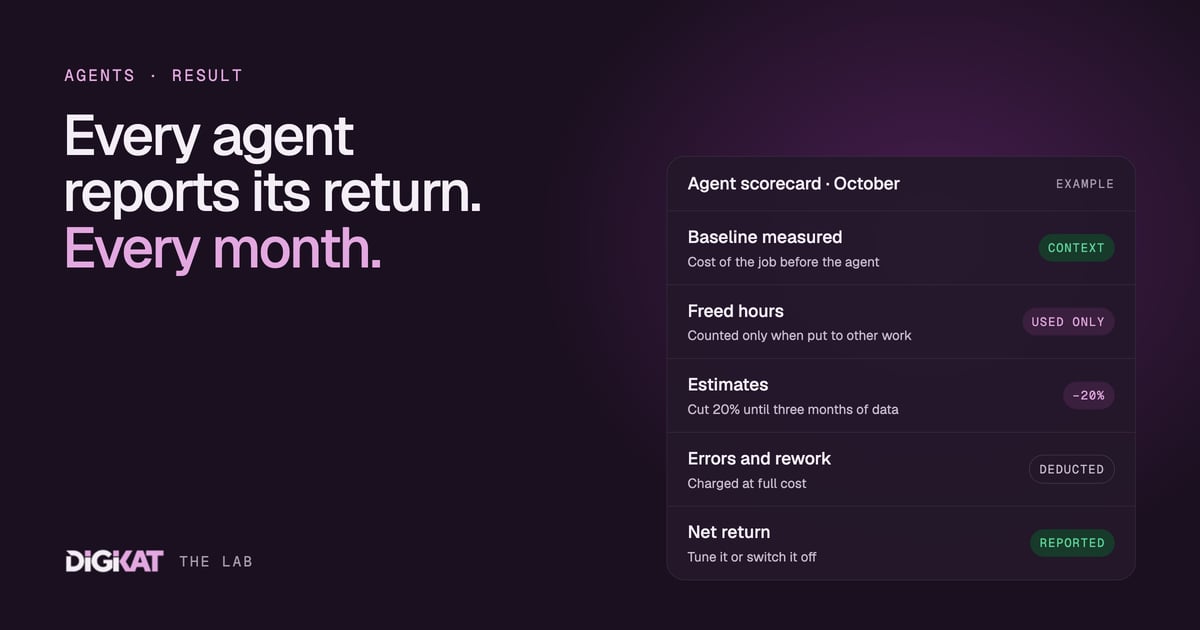
- Result. Every month, a scorecard for each agent: what it did, what it saved or earned, what it cost, and the net return.
Three rules that keep the numbers honest
A scorecard is only useful if you can trust it, so we hold ourselves to three rules.
- Time isn't money until it's used. Freed hours count only when your team puts them to other work, or a cost goes away.
- Estimates are discounted. Anything modelled rather than measured is cut by at least 20% until three months of real data confirm it.
- Failures are charged. Errors, escalations, rework and refunds come off the return at full cost.
These rules make our numbers smaller. That's the point.
What this means if you work with us
Every proposal now comes with a forecast of each agent's HubSpot credit and AI usage, and a cap you approve. Every agent ships with a label: what it reads, what it may change, what it must never do, and who approves its work. And every month you get the scorecard.
If an agent doesn't pay its way, we tune it or switch it off. That's part of the promise.
Why I care about this one
I've spent years building HubSpot systems for Australian businesses, and I've watched the same thing happen with every new wave of tools. Something gets switched on, everyone's excited for a month, and a year later nobody can tell you whether it paid for itself. AI is heading down the same road, only faster and with bigger bills. I'd rather show you a smaller number we can both trust than a big one neither of us can check. So we run the same scorecard on our own agents inside DigiKat first, before we ask anyone else to trust it.
Start with Context. The AI Readiness Audit checks your data, measures today's costs and ranks the agents that pay back first. Or see how we work.