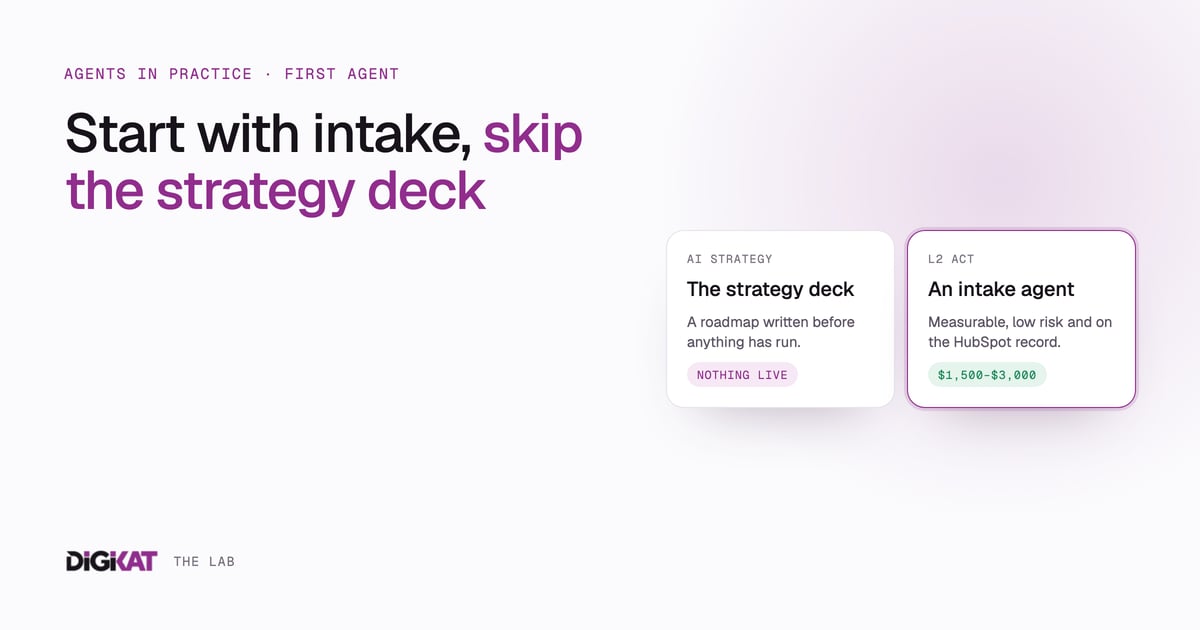
A lot of AI projects start with a strategy deck. A maturity model, a roadmap with three horizons, and a recommendation to "explore use cases". Six months later, nothing is running.
I'd rather start with something boring. An intake agent. A booking agent. Something that takes a job your team already does every day, does it faster, and writes everything to HubSpot. At DigiKat, that's an L2 agent: it captures details, writes to HubSpot, books and sends emails. The build is $1,500–$3,000, and it's $100 a month to run plus the $50 retainer for the website or portal it lives on (AUD, ex GST).
Here's why that's the right first move for most businesses.
What a boring agent looks like
Intake is the job of getting a new enquiry from "someone filled in a form" to "the right person has everything they need". Usually that means reading the enquiry, checking whether the person is already in HubSpot, asking for anything that's missing, sorting it by type and routing it to the right person.
Booking is the next step: offering times, confirming, reminding and rebooking.
Neither is exciting. Both happen many times a week, both follow a pattern, and both cost you customers when they're slow. That combination is exactly what an agent is good at.
Why intake first
It's measurable
You can measure intake before and after with numbers you already have, or can get quickly:
- Time from enquiry to first response.
- How many enquiries arrive complete, and how many need chasing.
- Enquiry-to-booking conversion.
- Minutes a day your team spends on lead admin.
- No-shows and reschedules, once booking is in.
Our lead-response system for a financial advisory client shows what this looks like. Response time went from 3.5 days to 18 minutes. Lead-to-meeting conversion went from 8% to 22%. Advisors' lead admin dropped from about 45 minutes a day to about 10. Those numbers belong to that firm, and yours will be different. The point is that they were easy to measure, because intake has a clear start and a clear finish.
Try measuring an AI strategy that way.
It's low risk
An intake agent handles information. It stays away from money, signatures and clinical decisions. In the worst case it asks a clumsy question or routes a lead to the wrong person, and someone can fix that in a minute.
It also starts in draft mode, like every agent we build. Replies wait for a person to approve them until they've proven themselves. In the advisory project, one draft to a grieving prospect jumped straight to logistics. The advisor caught it before it went out, and we added a rule so sensitive enquiries skip the AI entirely. That's the kind of lesson you want to learn on a low-risk job.
It's on the record
Everything an intake agent does lands on the HubSpot record: the contact, the enquiry details, the routing, the replies and the timestamps. That gives you three things.
- You can see the agent's work. Open the contact and it's there.
- Your data gets better. In the advisory project, the CRM data became accurate and the founder had a reliable pipeline view for the first time. Clean intake means clean data downstream.
- Your next agent has something to stand on. A booking agent, a document chaser or a renewals agent all depend on the record that intake creates.
It teaches you what you actually need
Run an intake agent for a couple of months and you'll know where enquiries really come from, what people ask, what's usually missing and where your team gets stuck. That's better input for the next agent than any workshop. It's often the point where a client says "we need a booking agent next", or "the real problem is the paperwork".
What's wrong with "AI strategy"
Thinking ahead is good. The problem starts when strategy replaces doing. A strategy deck is written before anyone has seen how your customers, your data and your team behave around an agent. It's guessing, carefully formatted.
Strategy also tends to aim high: phone receptionists, agent teams, a portal concierge that does everything. Those are real, and we build them. They're also L4 agents, at $6,000–$9,000 to build and $300 a month to run, with voice, several systems and more that can go wrong. They make far more sense once you have a working record and a team that trusts agents.
Our view is that strategy should come from evidence. Start with one boring agent, measure it, then decide what's next. If you want a broader frame for growing from one agent to several, our post on moving from workflows to an agent team covers it.
Getting the boring agent right
- Pick one entry point. One form, one inbox or one booking page. Add channels later.
- Write down the rules first. What counts as a complete enquiry? Who gets which type? What should never be automated?
- Build the queue. Drafts and exceptions need an owner. See build the queue before the agent.
- Measure the before. Capture your current response time and admin minutes before go-live, or you'll never know what changed.
- Keep the sensitive work human. Decide up front which enquiries skip the agent completely.
And if a plain workflow would do the job, use the workflow. Here's how we choose between an agent and a workflow.
The boring agent pays for the interesting ones
A working intake agent gives you faster responses, cleaner data and a team that's seen an agent behave well. Those three things make every later agent cheaper to scope and easier to trust. That's a better foundation than any slide.
If you'd like to see what a sensible first agent looks like for your business, try our free Build my solution tool. Pick your industry, answer seven quick questions, and you'll get a blueprint across your website, portal, agents and HubSpot record, with an estimate in AUD ex GST.