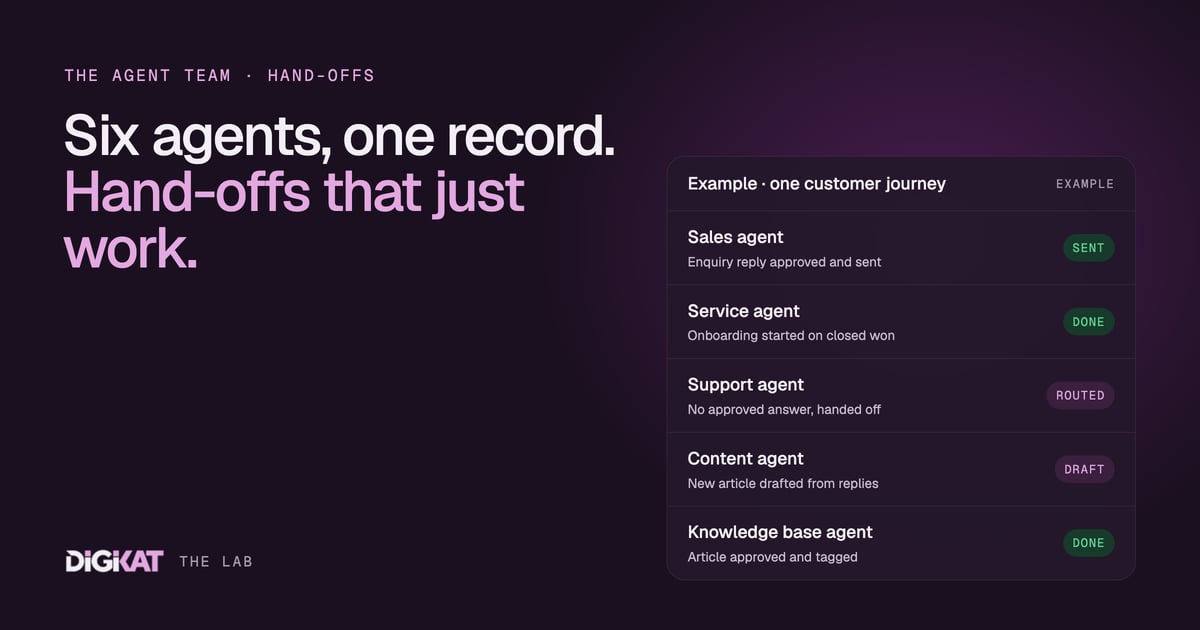
A good team doesn't need a meeting for every hand-off. Sales closes the deal, delivery picks it up, support knows the history, and everyone works from the same file. That's how we build AI agents too. Six agents, each with one job, handing work to each other through the same HubSpot records your people already use.
Over the past few months we've written about each agent on its own. This post puts them together and follows one customer from first enquiry to the support question that ends up becoming new content.
The six agents and their jobs
- Sales agent: works the sales pipelines. Qualifies enquiries, drafts follow-ups, keeps deals moving.
- Service agent: runs the service and delivery pipelines. Onboarding, project stages, chasing what's overdue.
- Support agent: answers customers across the help desk, website chat and portal chat, and hands off to a person with the full record.
- Marketing agent: builds segments from CRM data and drafts nurture, campaign follow-up and win-back.
- Content agent: reads the questions in tickets, chats, deals and calls, finds the gaps and drafts the missing content.
- Knowledge base agent: keeps the approved answers and assets, and tells the other agents what to send.
Each agent is narrow on purpose. One job, clear rules and a scorecard. The value comes from how they hand off.
How the hand-offs work
Our agents don't message each other in some hidden back channel. They hand off the same way a well-run team does: by updating the shared record. In HubSpot that means:
- Stage changes. A lifecycle stage moves from lead to customer, or a deal moves to closed won. Each agent watches the stages it owns.
- Associations. The deal is linked to the contact, the company, the onboarding project and later the tickets. Any agent can follow those links and see the whole picture.
- Tasks and tickets. When an agent needs another agent or a person to act, it creates a task or ticket in the right pipeline with a short note.
- Notes on the timeline. Every agent logs what it did and why, so the next agent and every person can read the history.
We write the hand-off rules down before anything goes live: which agent owns which stage, what triggers a hand-off, and what the note must include. Only one agent owns a record at a time. That stops a customer getting a nurture email and a sales follow-up on the same afternoon.
This is why we build on HubSpot. As we explained in why we build agents on HubSpot, structured data is the agent's map. Sales, service and project pipelines, tickets, invoices, custom objects and the associations between them all live in one place, so each agent has a structured flow to follow.
One customer, start to finish
Here's an illustrative example. Priya runs operations at a mid-sized building services company. Every name and detail is made up, but the flow is how our agents work.
1. The enquiry
Priya fills in the website form on a Tuesday night. The Sales agent creates the deal, checks the company record and sees two contacts there downloaded a guide last year. It asks the Knowledge base agent what's approved for a first-stage enquiry from a building services company. It drafts a reply with a relevant case study and a booking link. A salesperson approves it the next morning, and it goes out before nine.
2. The sale
Priya books a call. Afterwards, the Sales agent reads the call summary and notes she asked about onboarding time. It asks the Knowledge base agent for the approved onboarding timeline for the proposal stage and drafts the follow-up. The proposal, pricing and the signature stay with a person. When Priya signs, the salesperson moves the deal to closed won.
3. Onboarding
Closed won is the hand-off. The Service agent sees the stage change, creates the onboarding record in the delivery pipeline, associates it to the deal and company, and drafts the welcome email from the approved template. It chases the access details Priya's team needs to send and flags the project owner if anything is overdue. The Marketing agent sees Priya is now a customer and takes her out of the prospect nurture straight away.
4. The support question
Three weeks in, a member of Priya's team asks in portal chat how to add a new site to their account. The Support agent looks up the contact, sees the open onboarding project and asks the Knowledge base agent for an approved answer. There isn't one. The Support agent says so honestly, creates a ticket with a short summary and the associated records, and routes it to the onboarding lead, who answers within the hour.
5. The new content
At the end of the week, the Content agent groups the questions it's seen. "How do I add a new site?" has come up in several tickets and chats with no approved answer. It drafts an article from the best replies the team wrote, tags it for new customers and the account ticket type, and sends it to the Knowledge base agent for approval. The onboarding lead edits two lines and approves it. Next time anyone asks, the Support agent answers in seconds, and the Service agent adds the article to the onboarding emails.
Six agents touched Priya's journey. None of them needed a meeting. Every step is on the record.
Where the people sit
Look back at that example and count the approvals. A person approved the first reply, ran the call, sent the proposal, took the signature, answered the question the agent couldn't and signed off the new article. That's deliberate.
We use the same method for the whole team: Context, Action, Coordination, Result. In Coordination, people approve and agents act. An agent earns more freedom once 95% of its work has been approved unchanged for two weeks. Money, signatures and clinical or legal advice stay with a person, always. In Result, each agent gets its own monthly scorecard: what it did, what it saved, what it cost and the net return.
Why a team, and why now
Gartner has predicted that over 40% of agentic AI projects will be cancelled by the end of 2027. In our experience, the ones that fail are usually one big agent asked to do everything, on top of messy data with no clear hand-offs. Small agents with one job each, working off a clean, shared record, are much easier to test, trust and measure.
HubSpot is moving the same way. Its agentic customer platform puts agents alongside people on the same CRM. We use HubSpot's own agents first and build custom agents only where they stop, all connected to the same records.
You don't need all six on day one. Most businesses start with one, usually Support or Sales, and add the next once the first has earned its keep.
If you'd like to see what an agent team would look like on your HubSpot, build my solution and we'll map it out, or start with an AI Readiness Audit to check your data is ready. You can read more about how we work too.