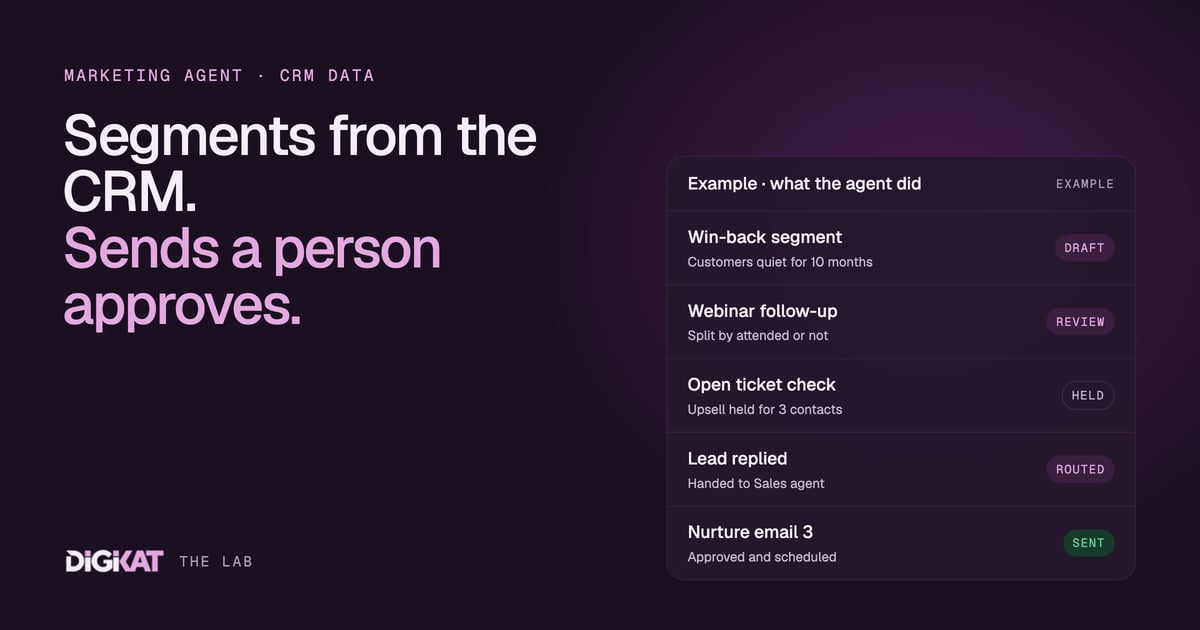
Most small business marketing runs on a monthly newsletter sent to everyone, plus good intentions about following up the rest. The webinar list never gets its follow-up. The customers who went quiet in March never hear from you again. The data to do better is already sitting in your CRM. The Marketing agent is how we put it to work, with a person approving every send.
This post is part of our series on the management agent team we build on HubSpot. The Sales agent runs the pipelines, the Support agent answers customers across the help desk, chat and portals. The Marketing agent works the space in between: the people who aren't in an active deal or an open ticket, but should still hear from you.
What the Marketing agent actually does
It has four jobs, and all four start from the CRM rather than from a blank email:
- Segments. It builds lists from real data: lifecycle stage, deal stage, products bought, last activity, membership status, location, source. Not "everyone who opened an email once".
- Nurture. It keeps leads and subscribers warm with sequences that match where they are, so a new lead and a customer of three years don't get the same email.
- Campaign follow-up. After an event, webinar, offer or launch, it sorts responders by what they did and drafts the next touch for each group.
- Win-back. It spots customers and members who've gone quiet and drafts a reason to come back, timed to when they'd normally have bought again.
None of this is new as a marketing idea. What's new is that an agent can do the sorting and drafting every week without anyone having to find the time.
Why the CRM is the agent's brief
A marketing agent is only as good as the data it segments from. In HubSpot, the signals it needs already exist as structured properties and associations:
- Lifecycle stage tells it whether someone is a subscriber, a lead, an opportunity or a customer.
- Deal stage and pipeline tell it what someone is considering and how far along they are. It can follow the association from a contact to their open deal and know not to send a generic promotion to someone mid-negotiation.
- Closed won and closed lost deals tell it who bought what, and who said no and why.
- Tickets tell it who has a problem right now. Nobody with an open complaint should get a cheerful upsell email, and the agent can check.
- Custom objects such as memberships, courses or services tell it what someone actually uses.
When this data is messy, the agent sends the wrong thing to the wrong person, faster than any human could. That's why we always check the data first, and why we wrote bad context in, bad agent out before we wrote about any single agent. If lifecycle stages haven't been maintained in two years, the first job is fixing that, not sending more email.
An example segment, step by step
Here's an illustrative example of how the agent might build a win-back segment for a service business:
- Contacts with lifecycle stage Customer.
- Associated to at least one closed won deal more than 10 months ago.
- No closed won deal since.
- No open ticket, and no open deal in any pipeline.
- Not unsubscribed, and not on the "do not market" list.
The agent drafts a short email for that group, suggests a send date and notes how many contacts are in it. A person reviews the list, edits the copy if needed and approves. If you run a gym or club, we covered the retention side of this in membership retention agents.
A person approves every send
This is the rule we don't bend. The Marketing agent drafts the segment, the copy and the timing. A person approves before anything leaves the building. Email to a list is public in a way a single reply isn't: one wrong merge field or one wrong segment goes to hundreds of people at once.
In practice the approval step looks like this:
- The agent creates the draft email and the list in HubSpot, and a task for the approver with a short summary: who's in it, why, what it says and when it should go.
- The approver checks the list size and a sample of contacts, reads the copy and either approves, edits or rejects with a note.
- The agent logs the outcome, so it learns which drafts go out unchanged and which get rewritten.
We wrote up the mechanics in approval-gated outreach in HubSpot. The short version: if automation can send without sign-off, eventually it will send something you regret.
How the Marketing agent works with the rest of the team
The Marketing agent doesn't work alone. It hands off through shared HubSpot records:
- When a nurtured lead replies or books a call, the Marketing agent hands the contact to the Sales agent by moving it to the right lifecycle stage and creating the deal or task. It stops nurturing that person so they aren't getting promotions and sales follow-up at once.
- When a campaign reply is really a support question, it routes it to the Support agent as a ticket.
- When it needs content for a segment, such as a case study for prospects in a particular industry, it asks the knowledge base for approved material rather than writing claims from scratch.
That's the point of building agents on one structured data layer. Each agent can see what the others have done because it's all on the same contact record.
Switching it on the right way
We follow the same four steps for every agent: Context, Action, Coordination, Result.
- Context: check lifecycle stages, deal data and subscription status. Pick one job, such as post-event follow-up, agree what done means and measure what it costs you today (often it's "we don't do it at all").
- Action: HubSpot's own tools first. Segments, workflows and HubSpot's AI features cover a lot. We add custom agent logic only where they stop, such as segmenting from a custom object or drafting copy from approved assets. We test on past campaigns before anything new goes out.
- Coordination: people approve, agents act. Even once 95% of drafts are approved unchanged for two weeks, the send itself stays with a person for list emails.
- Result: a monthly scorecard showing what it drafted, what was sent, what it cost and what it brought back, such as replies, booked calls or returning customers.
If you've got years of customer data in HubSpot and a marketing calendar that never quite happens, we can map out what a Marketing agent would do with it. Build my solution for a plan, or book an AI Readiness Audit to see whether your lifecycle and deal data is ready. You can see the full agent team on our agents page.