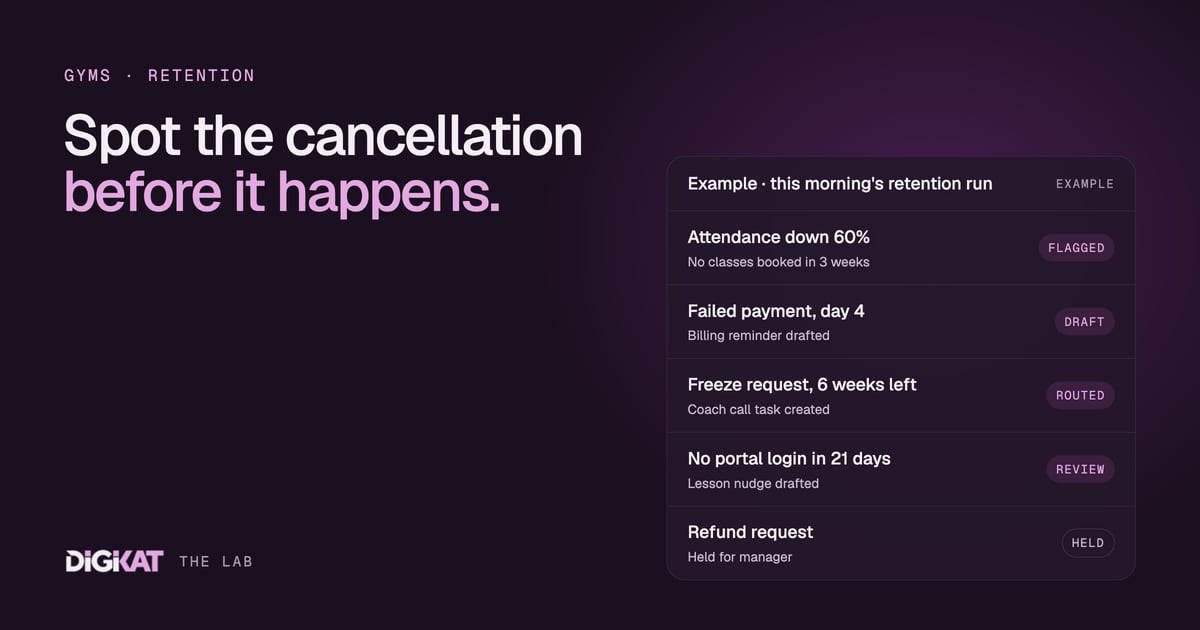
Most cancellations don't happen on the day the email arrives. They happen weeks earlier, quietly, when a member stops booking classes, stops logging in, or lets a failed payment sit. By the time the cancellation form lands, the decision is already made. A retention agent's job is to notice the quiet part, while there's still time to do something about it.
I've worked with gyms, wellbeing clubs and online membership businesses for years, and the pattern is always the same. The signals are there. They're just scattered across a booking system, a payments tool, a shared inbox and a coach's memory. Nobody has the time to join the dots for every member every week. That's exactly the kind of job an AI agent is good at, as long as the data underneath it is in order. If you're new to the idea, our plain-English guide to AI agents is a good place to start.
Why the warning signs get missed
Ask any club manager which members are about to leave and they'll name a few. They're usually right about those few. The problem is the other hundred they haven't thought about this week.
The early signs of a cancellation look like this:
- Attendance drops. A member who booked three classes a week is now booking one, or none.
- Logins stop. An online course member hasn't opened the member portal in a month.
- A payment fails and nobody follows it up for ten days.
- A freeze request comes in, which is sometimes a holiday and sometimes a soft goodbye.
- A complaint or a niggle sits in a support ticket, unanswered or answered badly.
- A contract end date is coming up with no renewal conversation booked.
Each of those is easy to spot on its own. Spotting them together, for every member, every week, is the hard part. That's a data problem before it's an AI problem.
Put the member on one record first
We build agents on HubSpot because HubSpot gives an agent a structured place to look. When the member's contact record holds everything, with the right associations, the agent doesn't have to guess. For a membership business, that record usually brings together:
- Memberships: which content and areas of the member portal they can access. Our step-by-step guide to setting up HubSpot memberships walks through the basics.
- Membership subscriptions: the plan, the billing cycle, the next payment date and any failed payments.
- Class bookings: a custom object or HubSpot's Appointments object, associated to the member, so attendance is a number you can trend.
- Tickets: every question, complaint and freeze request in the service pipeline.
- Activity: portal logins, email engagement and the last real conversation with a coach.
Once that's in place, "is this member drifting?" stops being a gut feel. It becomes a set of fields the agent can read and compare. If the booking data lives in one tool and the payments in another with nothing linking them, the agent will make confident mistakes. Fix the record first. If you run a gym, our post on scaling your gym with secure membership portals covers how the portal side fits in.
What the retention agent actually does
A retention agent isn't a magic churn score. It's a set of plain jobs, done every day, without anyone having to remember them.
1. It watches the signals
Each morning it checks members against the rules you agree up front. For example: attendance down by half over four weeks, no portal login in 21 days, a failed payment older than three days, or a freeze request on a plan with less than two months left.
2. It writes a short risk note
For each member who trips a rule, the agent writes a note on the record in plain words: what changed, when, and what's already been tried. A coach can read it in ten seconds.
3. It drafts the right next step
Not every drifting member needs the same thing. A failed payment needs a friendly billing reminder. A member who stopped coming after a coach left might need a personal call. A course member stuck on module three might need a nudge with the next lesson. The agent drafts the message or the call task, and picks from approved templates rather than inventing offers.
4. It routes it to a person
The draft goes to the right coach or manager as a task in HubSpot. They approve it, tweak it or bin it. Nothing goes out on its own in the early weeks, and nothing involving discounts, refunds or contract changes ever goes out without a person.
How we roll it out: Context, Action, Coordination, Result
We use the same four steps on every agent we build.
- Context. Check the data, pick one job (say, members who've stopped booking), agree what done means, and measure what it costs today. How many hours a week does the team spend chasing lapsed members, and how many slip through?
- Action. Use HubSpot's own tools first, such as workflows, lists and the Breeze agents, and only build custom where they stop. We test the agent on real past cases: last quarter's cancellations. Would it have flagged them, and when?
- Coordination. People approve, the agent acts. The agent earns more freedom once 95% of its drafts have been approved unchanged for two weeks. Money stays with a person: refunds, credits, price changes and contract variations are never the agent's call.
- Result. A monthly scorecard: how many members it flagged, how many were contacted, how many stayed, the hours saved and what it cost to run.
That last step matters. If the scorecard doesn't show a net return after a fair run, we change the job or switch it off.
Where it hands off to other agents
Retention is rarely one agent's job forever. Once the data sits in one place, other agents can share the work. A support agent answering portal chat can see the member's risk note before it replies, so it doesn't send a cheerful upsell to someone who just complained. A marketing agent can keep at-risk members out of the promotional campaign and put them in a gentler check-in sequence instead. A knowledge base agent can supply the approved answer to "can I pause my membership?" so everyone says the same thing.
That kind of hand-off only works because every agent is reading the same record. It's the main reason we build on HubSpot rather than bolting a chatbot onto a booking tool. If you want to see how lists and segments drive the follow-up, our post on targeted CRM campaigns for retention is a useful companion read, and our agents page shows the full team.
A good first agent for membership businesses
Retention is one of the best first jobs for an agent in a gym, club or online course business. The signals are clear, the cost of losing a member is easy to work out, and the work is repetitive enough that people stop doing it when things get busy. Best of all, the agent doesn't need to send anything on its own to be useful. A daily list of drifting members, each with a clear note and a drafted next step, is already more than most teams have today.
If you'd like to know whether your member data is ready for a retention agent, book an AI Readiness Audit and we'll show you what's there, what's missing and what to fix first. Or if you already know the job you want done, start with Build my solution and we'll map it out with you.