The quote went out on Tuesday. It was a good quote: fair price, clear scope, sent the same day you measured up. Then nothing. The customer didn't say no. They just didn't say yes, and with a week of jobs on, neither of you got around to the follow-up. Six weeks later you drive past and someone else's van is in their driveway.
Quotes don't die, they go quiet
Most trade quotes aren't lost on price. They're lost to silence. The customer gets three quotes, means to ring back, gets busy, and books whoever reminds them first. If you've ever had someone say "oh, I was going to call you", you know exactly how this goes.
Tradies are rubbish at following up quotes, and it's not laziness. You're on the tools all day. Ringing someone to ask "did you get my quote?" feels pushy. And there's no list. The quotes are spread across your quoting app, your sent folder and a notebook in the ute, so nobody can see which ones are still warm.
That's exactly the kind of job an agent is good at: boring, repetitive, rules-based, and easy to forget. A quote follow-up agent watches every open quote and makes sure each one gets a polite nudge at the right time, without you having to remember any of it.
What the quote follow-up agent does
Here's a typical sequence we set up. You set the timing, the tone and the words. The agent does the remembering.
- Watches the Quote Sent stage. Every job in your HubSpot Jobs pipeline that has a quote attached and no answer is on its list.
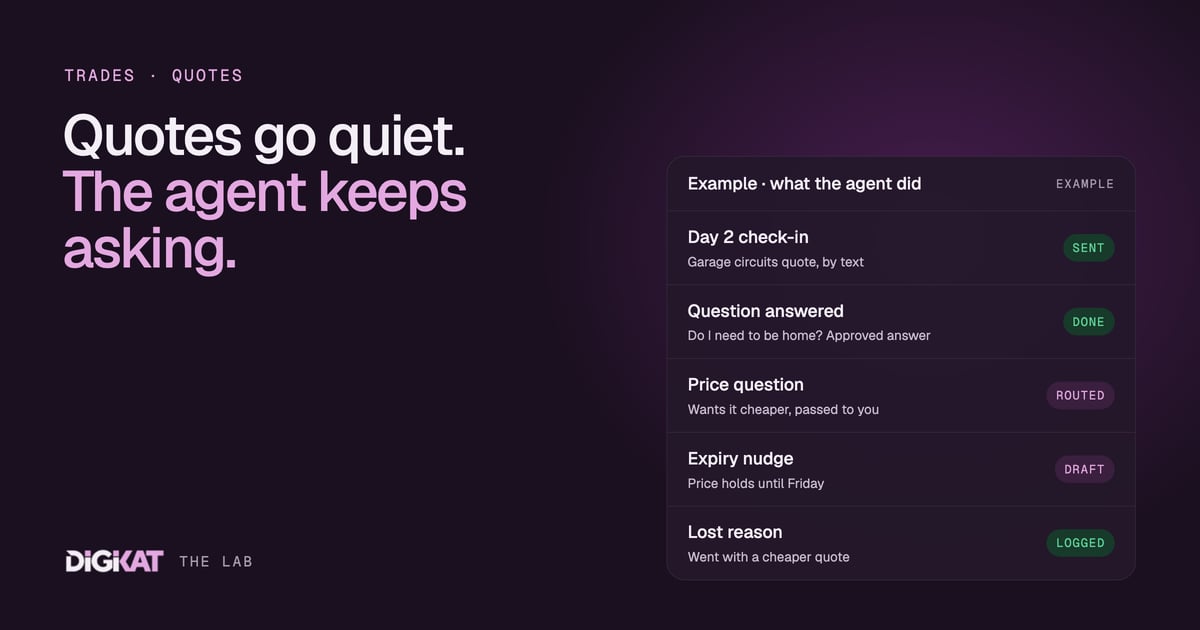
- Checks in after two days. A short text or email: did the quote come through, and is there anything you'd like explained? Written in your voice, signed by you.
- Answers the easy questions. How long will the job take, do you need to be home, what brand of hot water unit is that. It answers from information you've approved, and nothing else.
- Passes on the hard ones. "Can you do it cheaper?" or "can you add the back deck lights?" goes straight to you with a summary. The agent never discounts and never changes the scope.
- Makes a last call. Near the quote's expiry date, one final friendly message: the price holds until Friday, happy to lock in a date.
- Closes the loop. If they accept, the job moves to Booked and the agent offers appointment times. If they go elsewhere, it records the reason so you can see why you lose work.
That last step is worth more than it looks. After a few months you'll know whether you're losing quotes on price, on lead time or on silence, and that changes how you quote.
The data it needs to do the job properly
The agent can only chase what it can see. This is where a lot of AI projects fall over, and I wrote about it last week in why most AI agents fail. It's rarely the model. It's the data underneath.
For quote follow-up, the agent needs a few things on one record in HubSpot:
- The job, as a deal in a Jobs pipeline with honest stages (Enquiry, Site Visit, Quote Sent, Booked, Complete).
- The quote, linked to that job, with the amount, the line items and an expiry date.
- The customer, as a contact linked to the job, with a mobile number that actually works.
- The history: notes from the site visit, any calls, and whether they came in through the after-hours receptionist or a builder referral.
- A lost reason property, with a short list of options rather than a free-text box nobody fills in.
Because it's all associated, the agent can read the site visit notes before it writes the follow-up. "Hi Sarah, following up on the quote for the two new circuits in the garage" lands a lot better than "following up on quote #4471".
What stays with you
Money stays with a person. That's one of our fixed rules, and it matters in quoting more than anywhere.
- No discounts, ever, unless you've written the rule (for example, a standard pensioner rate you already offer).
- No scope changes. Extra work means a new or revised quote, and you write that.
- No dates outside the calendar. It offers real open slots, not promises.
- Drafts first. For the first couple of weeks, every message waits for your thumbs-up on your phone. Once 95% of them are approved unchanged for two weeks, the routine check-ins can go on their own. The tricky replies always come to you.
Approving a draft takes a few seconds. Writing the follow-up from scratch at 8pm takes ten minutes you don't have, which is why it never happens.
Start small, measure it, then decide
There's a lot of noise about AI right now, and plenty of it ends badly. McKinsey's latest State of AI found 88% of organisations use AI, but only 39% report any impact on earnings. Gartner predicts over 40% of agentic AI projects will be cancelled by the end of 2027. The ones that work tend to start with one small, measurable job.
Quote follow-up is a good one. Before we switch anything on, we count what you've got: how many quotes went out last quarter, how many were won, how many just went quiet. As an illustrative example, if you send 40 quotes a month and a third of them never get a reply, even winning a handful of those back each month adds up quickly. Then the agent's monthly scorecard shows what it chased, what it won back, what it cost and the net return. If it doesn't pay its way, we switch it off.
None of this replaces the way you sell. A good quote and a good reputation still win the work. This just makes sure nobody forgets to ask. If you want the bigger picture on what an AI agent is, or on systemising your sales process generally, those are good places to start. You can also see the full line-up on our agents page.
If you've got a pile of quotes that went quiet, let's turn them into booked jobs. Build my solution and we'll map a quote follow-up agent to your pipeline, your timing and your voice. Or, if you'd like to check your HubSpot is ready first, book an AI Readiness Audit.