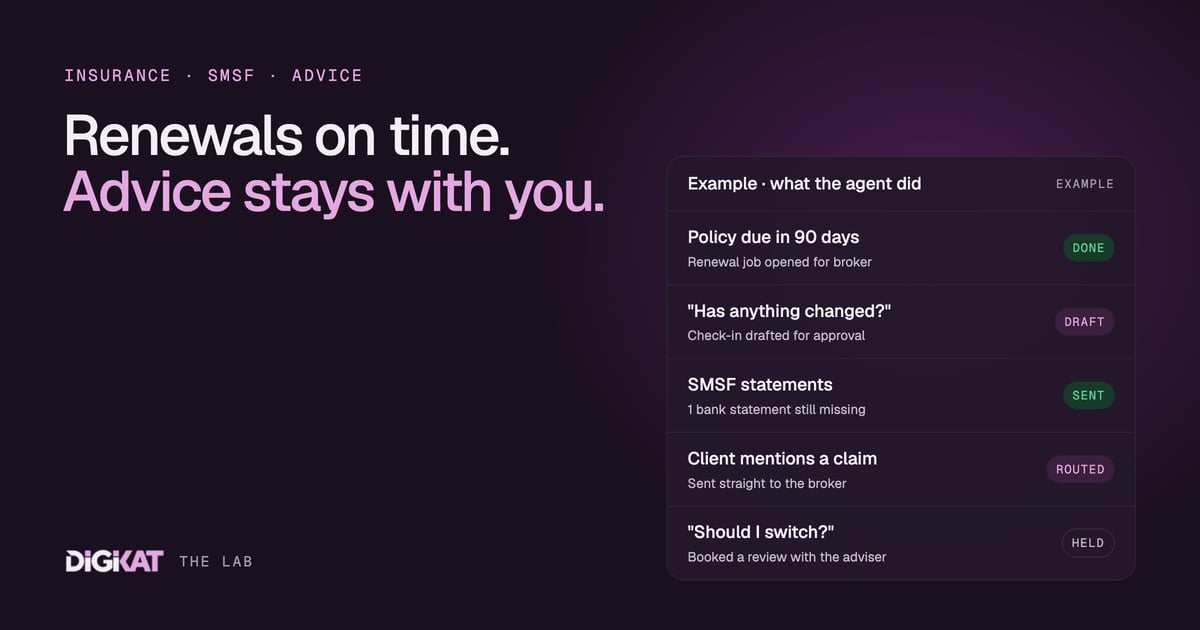
Renewals come around every year, and every year the same scramble follows. The broker finds out a policy is due when the insurer's notice lands. The SMSF administrator is still waiting on last year's bank statements. The adviser's annual review gets booked a month late, again. An AI agent can take most of that scramble off your team, provided it knows exactly where its job ends and the advice begins.
This post is for insurance brokers, SMSF administrators and financial advice firms. It covers how to treat renewals as a service pipeline in HubSpot, what the agent can and can't say, a renewal flow you can adapt, and the guardrails we put around it.
Renewals are a service pipeline, not a sales one
Most firms track renewals in a spreadsheet, a reminder in the practice software or someone's memory. None of those give an agent anything to work with. The fix is to model renewals as recurring service work in HubSpot.
Each client gets a record for every ongoing thing you do for them, using HubSpot's Services object: a home and contents policy, a business pack, an SMSF's annual compliance cycle, an ongoing advice arrangement. Each service carries its renewal or review date, the responsible person and its status. We explained why this works so well in HubSpot's new Services object, and how it gives agents the right shape of data in our post on the Listings and Services objects.
From there, each renewal or review becomes a job in a service pipeline, worked by the service agent that keeps delivery moving. Because the service, the client, the household and any related entities are all associated, the agent can fetch exactly the records it needs and nothing more.
What "inside the lines" means
In regulated work, the line between admin and advice is the whole game. So we write it down before we build anything.
What the agent can do
- Remind clients that a renewal or annual review is coming up.
- Ask for updated information, such as a change of address, new assets to insure, updated valuations or the year's statements for an SMSF.
- Chase missing documents, and stop the moment they arrive.
- Book review meetings with the right broker or adviser.
- Answer status questions: "Has my renewal been processed?" "Did you get my statements?"
- Send documents a qualified person has already approved, such as a renewal summary prepared by the broker.
What the agent never does
- Recommend a policy, a level of cover or an insurer.
- Suggest switching, cancelling or keeping anything.
- Comment on investment strategy, contributions, tax or retirement planning.
- Interpret policy wording or say whether something is covered.
- Handle money or accept instructions that commit a client to anything.
Anything that looks like a recommendation, or depends on the client's circumstances, goes to an authorised, qualified person. The agent says so plainly and books the conversation.
A renewal flow you can adapt
Here is an example flow for an insurance renewal. The timings are illustrative; every firm sets its own.
- 90 days out: the agent opens a renewal job on the service record and assigns it to the responsible broker.
- 60 days out: it emails the client a short "has anything changed?" check, with specific questions drawn from the policy type.
- 45 days out: it follows up on anything unanswered, and books a review call if the client has flagged changes.
- The broker prepares the renewal. This is human work: market, terms and recommendation.
- The agent sends the approved renewal pack, reminds the client before the due date and records their response on the job.
- Once renewed, it updates the service record with the new dates, closes the job and schedules the next cycle.
For an SMSF, the same shape works around the annual compliance cycle: request statements and valuations, chase what's missing, pass a complete file to the administrator and auditor, and keep the trustees informed of progress. For an advice firm, it's the annual review: request updated details, book the meeting, send the approved paperwork and track what's been signed.
The guardrails we build in
Good intentions aren't a control. These are:
- Draft first, always. Every agent starts by drafting. Messages land in an approval queue for a person to check. We explain how in approval-gated outreach in HubSpot.
- A queue someone owns. An approval step is only useful if someone actually clears it. Our post on building the queue before the agent covers why this is often the real bottleneck.
- Trigger words that route immediately. Claim, complaint, hardship, cancel, deceased, divorce, illness: any of these stop the agent and send the conversation to a person straight away.
- Earned freedom, with fixed limits. An agent can earn the right to send routine reminders on its own once 95% of its drafts have been approved unchanged for two weeks. Advice, money and signatures never move to the agent, however well it performs.
- Everything on the record. Every message, every response and every hand-off is logged against the client and the service, so your file shows exactly what was said and by whom.
How we measure it
We roll renewal agents out using the same four steps. Context: check the data (are renewal dates actually in the CRM?), pick one job, agree what done means and measure today's cost, such as hours spent chasing or renewals processed late. Action: HubSpot's own agents first, custom only where they stop, tested against last year's real renewals. Coordination: people approve, agents act. Result: a monthly scorecard showing what the agent did, what it saved, what it cost and the net return.
The point isn't to remove your brokers or advisers from renewals. It's to make sure they spend their renewal time on the part only they can do: the advice.
If your renewals live in a spreadsheet today, that's the place to start. Book an AI Readiness Audit and we'll check your data and map the first renewal flow, or go to Build my solution if you're ready to build. You can also read how we work with regulated firms.